
Asphalt Driveway FAQ's
Get Your Asphalt Paving FAQ's Answered
01. What Is The Lifespan Of An Asphalt Driveway?
Answer: With proper maintenance and upkeep, a properly installed asphalt driveway can last up to 20 or even 30 years.
02. How Much Does It Cost To Install An Asphalt Driveway?
The Short Answer: An asphalt driveway runs between $1.93 and $6.26 Per Sq Ft nationwide.
The Real Answer: It depends on many factors. Is it a brand new asphalt driveway on virgin ground or are you removing an replacing an existing asphalt driveway? Or are you overlaying (adding an additional layer) to an existing asphalt driveway?
Once the type of paving is determined, then, the size of the driveway, the amount of excavating and grading for proper water drainage, how much repair needs to be done before overlaying the driveway, the distance from the asphalt plant and the thickness of the asphalt all make each driveway price unique.
Also, price per Sq Ft increases as the size of a driveway decreases. The smaller the driveway, the higher the cost. The bigger the driveway, the lower the cost. This is due to the fixed costs associated with a driveway business.
- Ordering & Management of Materials.
- Materials Costs.
- Equipment Costs.
- Mobilization Fees.
- Labor Costs.
- Insurance Costs.
- Bookkeeping.
- Etc.
Asphalt driveway costs are determined by a strict calculated method that honest asphalt professionals use. Since every job is entirely different from the next, your job will not cost the same as the one down the street or the one in the next neighborhood over.
Want to know the real costs? Use the same asphalt calculator the professionals use.
Or, Get up to 3 FREE estimates from our certified asphalt driveway pros near you.
03. How Long Does It Take To Install An Asphalt Driveway?
The Short Answer: On an average, 1 to 3 days for the installation of an asphalt driveway.
The Real Answer: The amount of time it takes to install an asphalt driveway really depends on the size of the driveway, the condition of the existing soil, the amount of subgrade preparation for stabilization and drainage planning and the size of the crew and equipment.
04. Can Asphalt Be Installed Over An Existing Concrete Driveway?
The Short Answer: Yes… but it should be avoided at all costs.
The Real Answer: Installing asphalt over concrete has the potential for many future problems. Sure, it may look good at first, but the problems can pop up within days or a few short weeks.
The Potential Problems:
- The asphalt can chip off in big chunks, particularly if the new asphalt installed is less than 2″ thick.
- The asphalt will crack off at the edges of where the concrete ends.
- The control joints in the concrete will reflect up through the new asphalt.
- Any cracks or damaged areas in the concrete will reflect up through the new asphalt.
05. How Thick Should An Asphalt Driveway Be?
The Short Answer: The absolute minimum asphalt thickness should be is 2″.
The Real Answer: Is the discussion of thickness before compaction, or after compaction?
Think about it. Once the asphalt is laid on the ground, it must be compacted with a roller. Therefore the thickness is much different than when it was initially laid.
The absolute minimum an asphalt driveway should be paved is 2″ after compaction. A lot of driveways are 3″ thick after compaction. A good number of them are 4″ thick after compaction.
But what’s the condition of the soil it’s being installed on? An asphalt driveway is only as good as what’s beneath it, regardless of the thickness.
06. How Should The Edges Be Finished On An Asphalt Driveway?
The Short Answer: Compacting the edges of the asphalt after it has been laid, helps make the edges more durable.
Additional Information: There are varying opinions on how the edges should be finished on an asphalt driveway. Some companies believe it’s a waste of time and money to compact them. Some will even flat out refuse to do it. Others won’t pave an asphalt driveway without compacting the edges.
But what’s more important, is if the edges are “locked in” or left open and visible. Adding a shoulder to your asphalt driveway will help lessen the chances of cracked edges tremendously.
We cover the topic of asphalt edges in great detail in one of our articles.
07. Should Base Be Installed Prior To Paving A Driveway?
Answer: An asphalt driveway is only as stable as what’s beneath it.
Is it clay and expands and heaves? Is it sandy? Then a solid base should be installed before paving the driveway.
Is the natural soil decomposed granite or has there been a base material installed previously? Then likely there is no need to add base material.
We wrote an article about adding base material to an asphalt driveway that covers the topic in more detail.
08. Should A New Asphalt Driveway Crack?
The Short Answer: Yes. Asphalt by nature cracks.
Unfortunately it’s not IF a new asphalt driveway will crack, but WHEN and WHERE it will crack. It’s the nature of just about any outdoor hard surface and can be compounded by the climate you live in.
On The Other Hand: Many cracks soon after installation could be a sign of a poorly installed asphalt driveway. If you’re seeing cracking on your new asphalt driveway, something could be very wrong.
09. How Soon Should An Asphalt Driveway Be Sealed After Installation?
Answer: A minimum of 6 months after installation.
Most asphalt sealer manufacturers recommend waiting until your new asphalt driveway is 6 months old before sealing it.
Sealing your asphalt driveway too soon can damage the surface of the asphalt and cut it’s life expectancy.
Get Your Asphalt Maintenance FAQ's Answered With Confidence
01. How Frequent Should Cracks Be Sealed?
Answer: Keeping cracks sealed up from moisture is extremely important and, if possible, should be done every year.
02. How Much Does Seal Coating An Asphalt Driveway Cost?
The Short Answer: Sealing or “Sealcoating” an asphalt driveway runs between .15¢ and $1.25 Per Sq Ft nationwide.
The Real Answer: It depends. Is it a brand new asphalt driveway being sealed or an existing asphalt driveway with a rough surface? Newer, smoother asphalt will use less sealer material than older, rough asphalt.
Other factors that may effect the cost are the type and quality of sealer being used, the amount of cleaning needed before applying the sealer, the amount of repairs or patching that needs to be done before sealing the driveway, if any, and how much crack sealing needs to be done, if any.
These things combined determine the cost to seal an asphalt driveway.
No two driveways are ever the same. The cost to seal your driveway isn’t going to be the same as the neighbor next door or the neighbor down the street.
Get up to 3 FREE estimates from our certified asphalt driveway driveway pros near you.
03. How Soon Should An Asphalt Driveway Be Sealed After Installation?
Answer: A minimum of 6 months after installation.
Most asphalt sealer manufacturers recommend waiting until your new asphalt driveway is 6 months old before sealing it.
Sealing your asphalt driveway too soon can damage the surface of the asphalt and cut it’s life expectancy.
04. How Often Should An Asphalt Driveway Be Sealed?
The Short Answer: An asphalt driveway should be sealed every 3 to 5 years.
Extended Answer: The frequency an asphalt driveway should be regularly sealed is dependent on the quality of the sealer used along with the amount and type of traffic on the driveway.
Steer clear of driveway sealing companies that recommend sealing your asphalt driveway every year or even every other year. Sealing your driveway too frequently can cause premature deterioration resulting in the driveway needing to be replaced much sooner than expected.
05. How Many Coats Of Asphalt Sealer Should Be Applied?
Answer: It depends on they type of application. Spray application, 2 coats. Squeegee application, 1 coat is sufficient.
06. Are There Any Other Colors Of Asphalt Driveway Sealer Besides Black?
Answer: Yes! There are beautiful asphalt sealing colors that can be purchased.
See colorful design ideas for asphalt driveways for more information.
07. Can I Pressure Wash My Asphalt Driveway?
Answer: Yes. It’s safe to use a pressure washer on your asphalt driveway. However, if your driveway is rough and rocky and has significant damage, the high pressure of the water can damage the asphalt even further.
08. Which Asphalt Sealing Application Is Better? Spray or Squeegee?
Is Spray or Squeegee Better For Asphalt Driveways?
When it comes to asphalt sealer application, the truth is, either one is better than none at all.
Spray Application
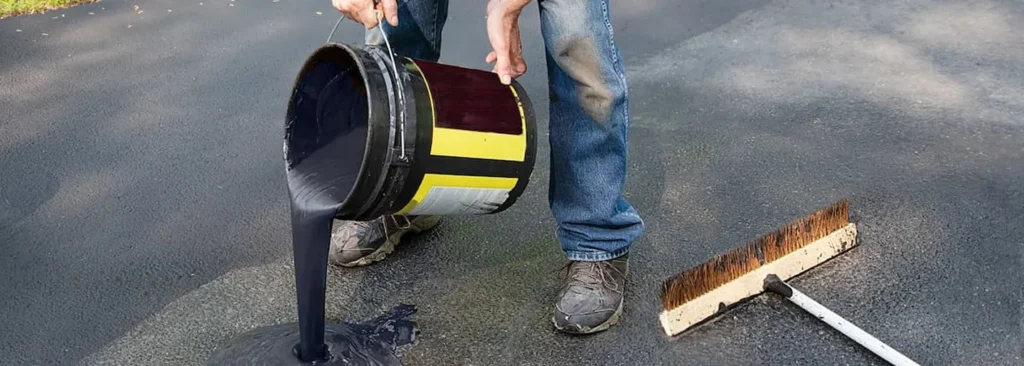
For an even wear, we always recommend a spray application. It’s fast, it uses a bit less material, but it can be messy. As the sealer wears, it wears more evenly which looks much better aesthetically when the time comes to have it sealed again. It takes the urgency out of needing to have it done to look better.
Squeegee Application
For a more durable application, we prefer a squeegee application. It takes more time and uses more material, but it lasts much longer. However, it wears unevenly leaving visible brush marks as it ages. This increases the urgency of needing it done when the time comes since its not as pleasing aesthetically.
09. Will Asphalt Sealer Track Into My Home?
Once the asphalt sealer is dry, which can take from 6 to 24 hours, it’s safe to walk on.
Be aware though, the dry sealer can still turn the soles of your shoes slightly black and can be tracked into your home.
10. Is Driveway Sealer Hot Or Cold?
This is a very frequently asked question. Logically, it seems like asphalt sealer would be a hot application doesn’t it? Surprisingly, it’s not.
Asphalt Driveway Sealer Is Cold.
11. Will Sealcoating Make My Driveway Look New Again?
Sealing an asphalt driveway is great for extending the life of the pavement, particularly if it’s done on a regular basis with a quality product.
Sealcoating can make a driveway look almost new again. It depends on the current condition of the asphalt.
If it’s fairly smooth, has no need for any patching, and there is little or no cracking, sealcoating can make a driveway look almost brand new again!
However…
If you have a driveway that looks pretty beat up, don’t be fooled into thinking an inexpensive sealcoat application will make your driveway suddenly appear new again. It won’t!
As a matter of fact, something one of my former bosses used to say and I got a pretty good laugh from was, “Sealcoating a raveled, cracked up and deteriorated asphalt driveway would be like repainting a wrecked car. It may have a fresh coat of paint, but it’s still a wrecked car!”
It’s true!
12. How Thick Is Asphalt Sealer?
Driveway sealer is similar to painting wood. Once it’s dry, we can still see the natural contours of the surface, but they’ll be much less evident depending upon the age of the asphalt and the amount of raveling and cracking that has occurred.
Imagine the difference between painting a rough cedar board vs a smooth sanded board. The end result is, the rough cedar board is still rough but much less.
13. Asphalt Sealer Types – What Are They?
Asphalt Driveway Sealers: Water based Or Oil Based?
Asphalt sealers come in both oil and water based. However, most reputable contractors use water based sealers.
Water based sealers can be an asphalt emulsion sealer, coal tar sealer or a mixture of both. Coal tar sealers are slowly getting phased out of the market as they are claimed to be carcinogenic and bad for the environment. As a matter of fact some states have banned coal tar based sealer.
Oil based sealers are also becoming more and more rare these days as they are high in VOC’s and are not good for the environment either. While there are some good contractors out there who use use oil based sealers, unfortunately, they’re few and far between. Most, not all, contractors that use oil based sealers are not applying the sealer per manufacturers specifications.
So why do they use them?
To increase profits!
Learn more about this and more by reading the Asphalt Maintenance Scam Survival Guide!
14. Are there additives that can make the asphalt sealer more durable?
Asphalt sealer manufacturers generally offer additives like rubber, sand, hardeners and poly that will add more durability to asphalt sealers and help them last much longer than sealers purchased at a building supply store.
Sealer purchased straight from a company that manufactures asphalt sealer, is by far a much higher quality product.
To top it off, the cost is generally about the same price as the building supply stores.
15. How Do I Get Old Oil Stains Off My Asphalt Driveway?
Left untreated, oil spots on asphalt can slowly eat away at the binders and can cause irreparable damage.
With that in mind, it might be better to clean them yourself rather than waiting for the next time you hire a contractor to reseal your driveway to clean them.
Clean oil spots using a commercial de-greaser, a broom and water.
You may have to brush and rinse a few times to get all of the oil off but in the end it’s well worth the effort. Just be sure to completely rinse off the commercial de-greaser entirely.
Protect Yourself!
Register for our free eBook and Video series.
Protect Yourself!
Register for our free eBook and Video series.